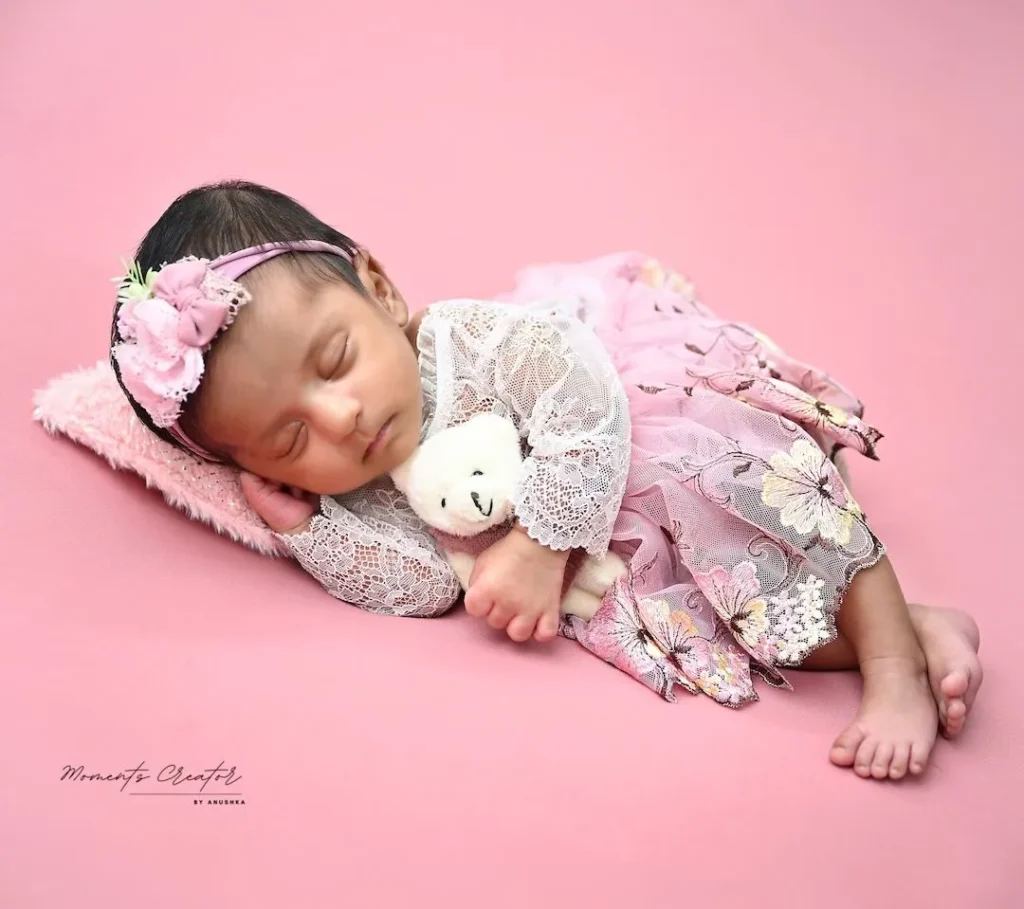
“We Already Did the Photoshoot at the Hospital.” Here’s What You Still Don’t Have.
What the Hospital Shoot Captures — and What It Cannot
She was two days old. Someone knocked on the door of the hospital room around eleven in the morning, carried in a wicker basket and a knitted cap, and took forty photographs in about twenty minutes. You were still on the bed. Your hair was not done. You had slept perhaps three hours in two days.
The photographs arrived a week later, and they were sweet. So the newborn photoshoot was done. Ticked off the list.
Then three months passed. And one evening, scrolling back through your phone, you went looking for the photograph of her fingers curled around your thumb — the way they did in that first fortnight, before her hands opened out into a toddler’s — and you realized it wasn’t there. Nor was the shape of her feet at that size. Nor a single frame of the two of you together, both rested, both finally present.
This article is about the gap between the two. Because they are two different things, and almost nobody explains the difference before it’s too late to fix.
At Moments Creator by Anushka, we have photographed more than 3,000 families across Delhi NCR over the past decade, and this has quietly become the most common conversation we have with new parents. They arrive convinced they missed the window. Most of them haven’t. Anushka — an internationally certified, award-winning newborn photographer working from our Dwarka studio — has spent years explaining what a hospital shoot is and what it was never designed to be.
Why So Many Delhi NCR Parents Believe the Newborn Shoot Is “Already Done”
Nearly every premium maternity hospital across Delhi NCR — in Dwarka, Gurgaon, Noida, and beyond — now includes a newborn photo session in the delivery package. It arrives bundled with the room, the meals, and the discharge paperwork.
This is a genuinely lovely thing to offer. It is also the source of the confusion.
Because the images look, at a glance, like newborn portraits — a wrap, a cap, a basket, a baby — parents reasonably conclude they have received the same thing a specialist newborn studio would have produced. They haven’t. They have received something different, valuable in its own right, and internationally recognized by a name most Indian parents have never encountered.
Once you know that the two things have separate names, the whole decision becomes obvious.
The Profession Has a Name for What the Hospital Gave You
It’s called a Fresh 48, and it is one of the most beautiful genres in photography.
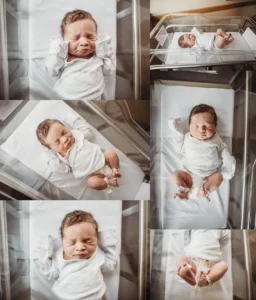
A Fresh 48 is documentary work, shot within the first forty-eight hours. The photographer arrives and photographs what is already happening. The baby stays in the bassinet or in your arms. There is no posing. There are few props. The light is whatever comes through the hospital window. The purpose is not to make the baby look a particular way — it is to record the day she arrived.
What a good Fresh 48 preserves:
- The hospital room, exactly as it was
- Your face in the first hours — undone, exhausted, luminous
- The first hold, the first feed, the first visitors
- The wristband, the name card, the crib tag
- The unrepeatable weather of that specific day
This is history. It cannot be recreated later, and if your hospital offered it to you, you are fortunate to have it.

What a Posed Newborn Photoshoot Actually Is
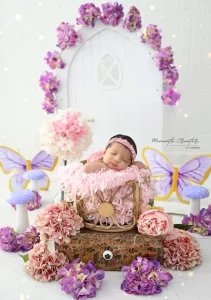
A posed newborn session is not documentary. It is portraiture — closer to art direction than to record-keeping.
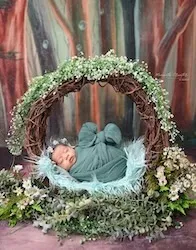
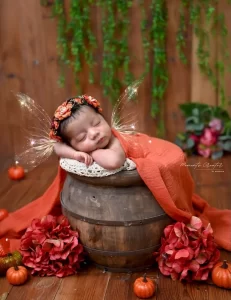
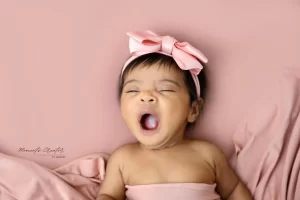
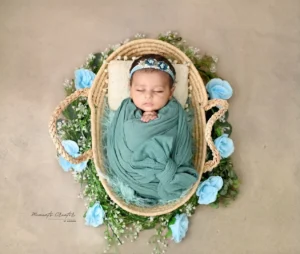
Here, the photographer is not capturing an event. She is composing an image: choosing the light, the palette, the texture of the wrap, the precise angle at which a sleeping baby’s chin comes to rest on her own hands. The baby is fed, warmed, settled, and gently guided into position over two or three unhurried hours. Themes are built. A mother, now a fortnight into recovery, sits for a portrait she is actually willing to hang on a wall.
What a posed session preserves:
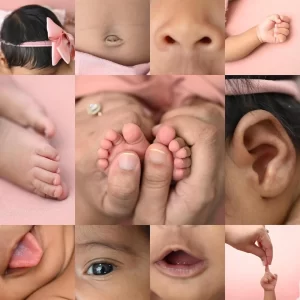
- Curled fingers and toes at the exact scale they will never be again
- Eyelashes, the whorl of hair at the crown, the fold behind the knee
- Styled, art-directed frames drawn from a library of curated themes
- A family portrait made when the mother feels — and looks — like herself
- Printed heirlooms: an album, a framed portrait, something physical
One records the day. The other records the baby.
Hospital Shoot vs Studio Shoot: The Honest Comparison
| Hospital shoot (Fresh 48) | Studio newborn photoshoot | |
| When | First 24–48 hours | Day 10 to Day 25 |
| Where | Hospital room | Climate-controlled studio, or your home |
| Style | Documentary — baby as she is | Portraiture — art-directed |
| Handling | Minimal; parents hold the baby | Guided posing, wrapping, settling |
| Duration | 20–40 minutes | 2–3 hours, baby-led |
| Mother in frame | Hours after delivery | Recovered, styled, makeup and hair done |
| Props & themes | Few or none | Curated setups, wardrobe, backdrops |
| The question it answers | What did the day look like? | What did our baby look like? |
| Can it be redone? | Never | Only within the newborn window |
Neither column is better than the other. They answer different questions.
Why Newborn Photographers Wait Ten Days — And Why It Is Biology, Not Scheduling
Parents often assume the ten-day wait is about the photographer’s diary. It is the opposite. The window exists because of the baby.
The curl. For roughly the first three weeks, a newborn keeps the flexed, folded posture she held in the womb. Placed on her side, she curls. Her knees draw to her chest. This is the posture every iconic newborn photograph depends on — and it fades. By the fifth or sixth week, it is largely gone.
The sleep. In these early weeks, newborns fall into deep, sustained sleep cycles that allow a photographer to work slowly and gently. Later, sleep grows lighter and breaks more easily.
The skin. In the first days, skin is often ruddy, mottled, and mid-peel, and the umbilical stump is still healing. By day ten to fourteen, this has settled.
The mother. On day two, she has just delivered. On day fifteen, she can sit for a portrait, in a gown she chose, and look into a camera as herself.
We’ve written a full guide to this — see our complete guide to the best time for a newborn photoshoot — but the short answer is this: days 10 to 25 are when the baby is most photographable, and the mother is most ready.
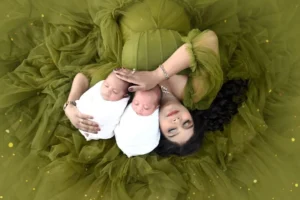

The First Forty-Eight Hours Were Never Meant for a Camera
There is a second, quieter reason the profession waits.
The World Health Organization’s guidance is unambiguous: immediate, continuous, uninterrupted skin-to-skin contact between mother and baby should be the standard of care after every birth. A large 2025 Cochrane review — drawing on sixty-nine trials and more than seven thousand mother–infant pairs — found that early skin-to-skin contact improves a newborn’s temperature regulation and blood glucose, and makes exclusive breastfeeding substantially more likely a month later.
Nothing in that evidence says a hospital photoshoot is harmful. A documentary photographer standing quietly by a window, photographing a mother holding her baby, disturbs nothing at all.
But it does explain why elaborate posing, undressing, and prop work is not what the first two days are for. A newborn cannot yet regulate her own temperature well. Her airway is soft and her head is heavy relative to her neck. Those hours belong to warmth, feeding, and rest.
So this is not a criticism of hospital photography. It is simply the reason the posed session lives on day fifteen — where the baby is safe, settled, and at her most beautiful.
If You Can Only Choose One
If budget, energy, or circumstance allows only one session, our honest advice — offered after ten years of photographing newborns in Dwarka, Janakpuri, Rohini, Gurgaon, and Noida — is to choose the studio session.
The hospital shoot gives you a record of a day. The studio session gives you a portrait of a person, at the only stage of life she will ever look like that, made to be printed and passed down.
And if you already have the hospital images: wonderful. You are holding the first half of the story. There is still time for the second. Even if your baby is now past twenty-five days, don’t despair — sessions remain beautiful up to around six weeks, and our infant photoshoot at two to four months captures an entirely different and equally precious stage.
What to Actually Look For When Choosing a Newborn Photographer in Delhi NCR
Here is something almost no parent knows: no medical or government body anywhere — not the Indian Academy of Pediatrics, not NABH, not the WHO — has issued a standard governing newborn photography. There is no license. There is no certification anyone is legally required to hold.
Which means the parent’s own vetting is the safety standard. Ask any photographer, including us:
- Is the person photographing my baby the same person who will handle my baby? At many studios, they are not.
- Who else is in the room? For many mothers, an all-female environment is not a preference. It is a precondition.
- How are the difficult poses achieved? A baby should never be genuinely unsupported.
- Is the session baby-led? Feeds, breaks, and stopping the moment the baby says stop.
- How is hygiene handled? Freshly laundered wraps for every session, sanitized props, hand hygiene before contact.
- Is the room temperature-controlled?
And one myth you can safely retire: camera flash does not damage a newborn’s eyes. Pediatric ophthalmologists are clear about this. Direct your attention instead to posing, temperature, and hygiene — where the real considerations live.
For a fuller treatment, read our guide on newborn photography safety.
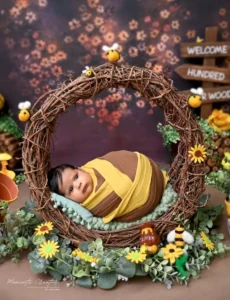
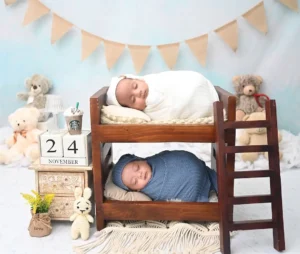
Why Parents Across Delhi NCR Choose Moments Creator by Anushka
- Anushka photographs and handles every baby herself. Not an assistant. Not a junior. The artist you booked is the person holding your child.
- A 100% female team. For a mother fifteen days postpartum, sitting for a family portrait, this changes everything.
- Never more than two sessions a day. Newborn work cannot be rushed, and yours will not be.
- 400+ curated themes, developed in-house — not stock setups recycled between clients.
- Premium wraps, wardrobe, props, and in-house makeup and hair are included in the package rather than sold as extras.
- A warm, sanitized, climate-controlled Dwarka studio, built specifically around newborns, with freshly laundered linens for every single session.
- Home sessions are available across Delhi and Gurgaon if leaving the house feels like too much.
- 3,000+ families, a decade of work, international awards, and 200+ five-star reviews.
Explore our newborn photoshoot packages, or plan ahead with a maternity photoshoot in Delhi NCR — many families book both together.
Frequently Asked Questions
We already had a photoshoot at the hospital. Do we still need a newborn session?
Most parents find they do. A hospital shoot captures the event of the birth, but not the styled portraits, the curled newborn poses, the family frames with a recovered mother, or the printed albums that a studio session is built to produce. The two are complementary rather than interchangeable.
What is the difference between a hospital newborn photoshoot and a studio photoshoot?
A hospital shoot, known in the profession as a Fresh 48, is documentary photography taken within the first 48 hours, recording the day your baby arrived with no posing or props. A studio newborn photoshoot happens between day 10 and day 25 and is art-directed portraiture with themes, wraps, styling, and a family portrait. One records the day; the other records the baby.
Why do newborn photographers wait until 10 to 25 days?
Because of the baby. Newborns retain their curled, womb-like posture and deep sleep cycles for roughly the first three weeks, which is what makes gentle posing possible. By day 10 to 14 the skin has settled and the umbilical stump has healed, and the mother has recovered enough to be photographed comfortably.
Is it safe to photograph a newborn in the first few days?
Documentary photography, where the baby stays in the bassinet or in a parent’s arms, is very low risk. Elaborate posing, undressing, and prop work are best deferred because newborns in the first days cannot regulate their temperature well, and those first hours are clinically meant for skin-to-skin contact and feeding. This is why the profession waits.
Does a camera flash harm a newborn’s eyes?
No. Pediatric ophthalmologists are clear that a brief, diffused camera flash does not damage a newborn’s retina. The genuine considerations in newborn photography are safe posing, room temperature, and hygiene, not flash.
My baby is already over 25 days old. Have we missed the window?
Not necessarily. Beautiful newborn sessions are still possible up to around six weeks, though the baby will be more awake and the classic curled poses harder to achieve. Beyond that, an infant session at two to four months captures a completely different and equally precious stage.
Do you provide the wraps, outfits, and props?
Yes. Every newborn session at Moments Creator includes wraps, baby outfits, backdrops, curated props, a mother’s gown, and in-house makeup and hair styling. You bring your baby; we handle everything else.
Ready to Tell the Second Half of the Story?
The hospital photographed the day she arrived. This is the record of who she was.
Whether you are booking ahead from your second trimester or sitting at home on day nine wondering whether you have left it too late, every newborn session at Moments Creator by Anushka is planned personally, photographed personally, and paced entirely around your baby. Ten years, three thousand families, and one photographer who has never once handed your child to somebody else.
📍 Studio: Moments Creator by Anushka, Dwarka, New Delhi 📲 WhatsApp: +91 9711321057 🌐 Explore packages: Newborn Photoshoot — Delhi, Gurgaon, Noida
Some photographs record a date. Others record a person. Let’s make the second kind.